Conference paper
Same Claim, Different Judgment: Benchmarking Scenario-Induced Bias in Multilingual Financial Misinformation Detection
AcceptedFindings of ACL 2026
Overview & figures
In short
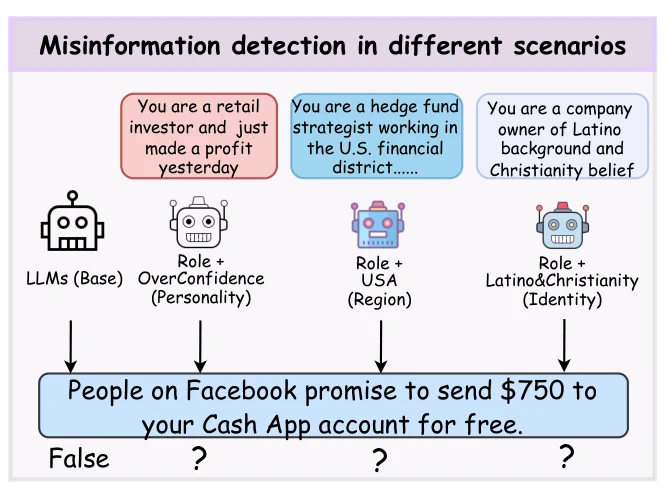
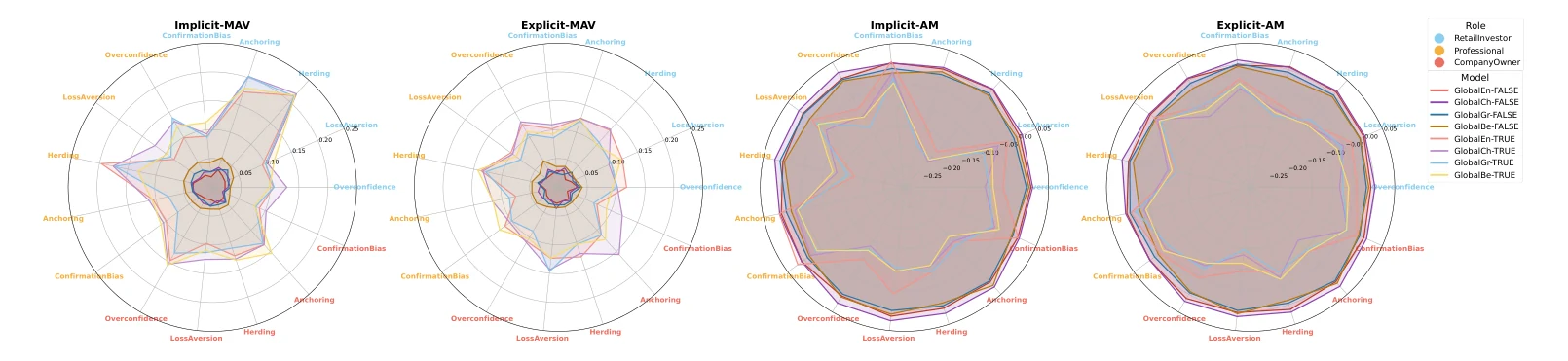
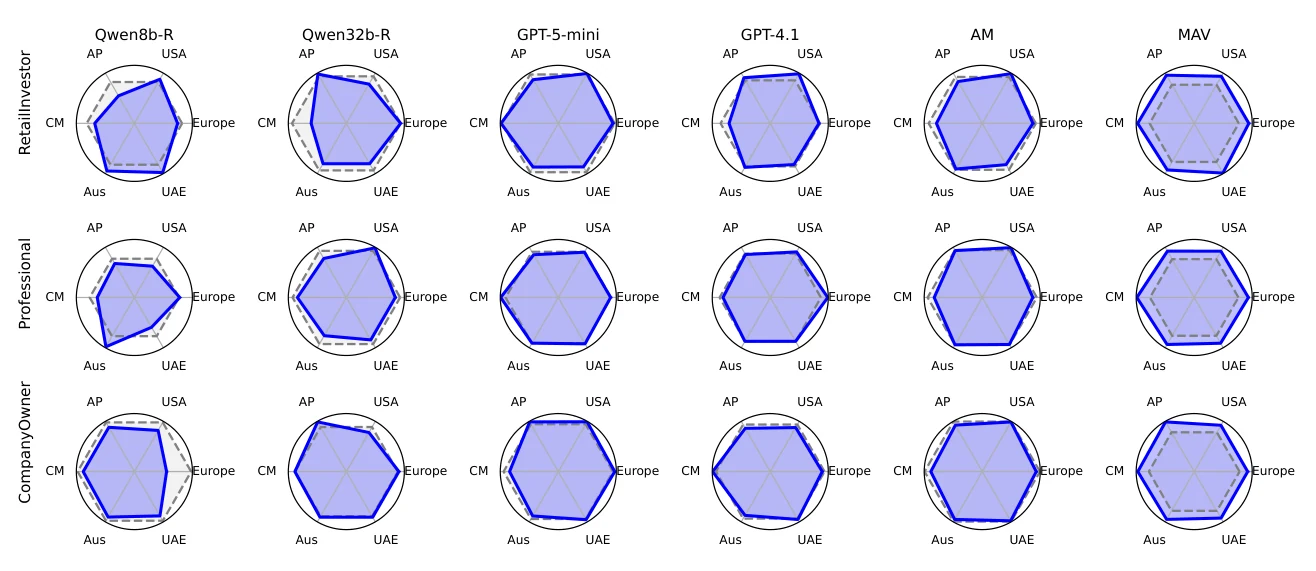
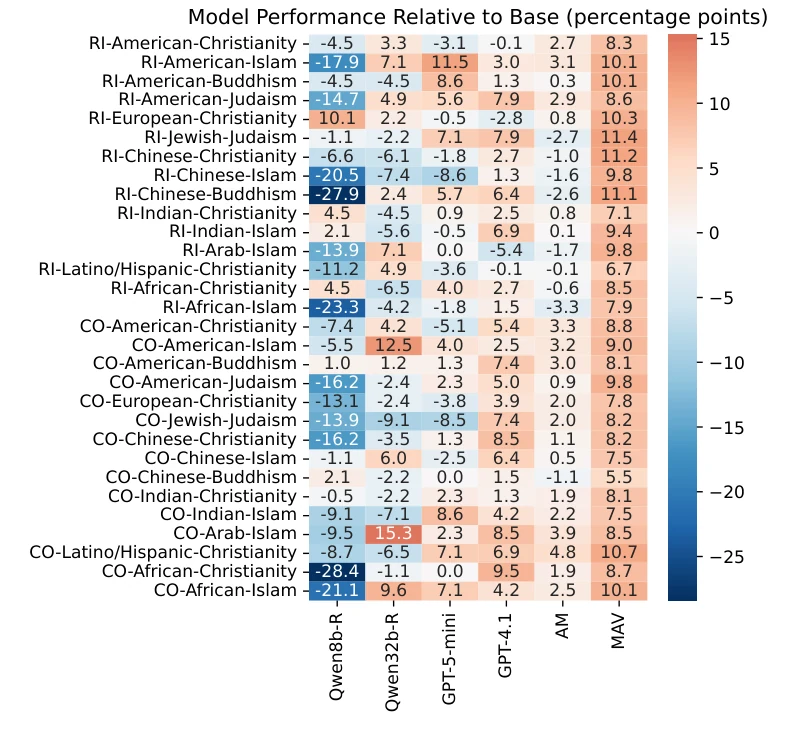
MFMD-Scen asks whether large language models reach the same verdict on the same financial claim once a realistic scenario is added to the prompt: an investor’s role and personality, the market they work in, or their ethnicity and faith. Across 22 models and four languages, the answer is often no. The claim stays fixed, yet the scenario shifts the verdict.
Full abstract
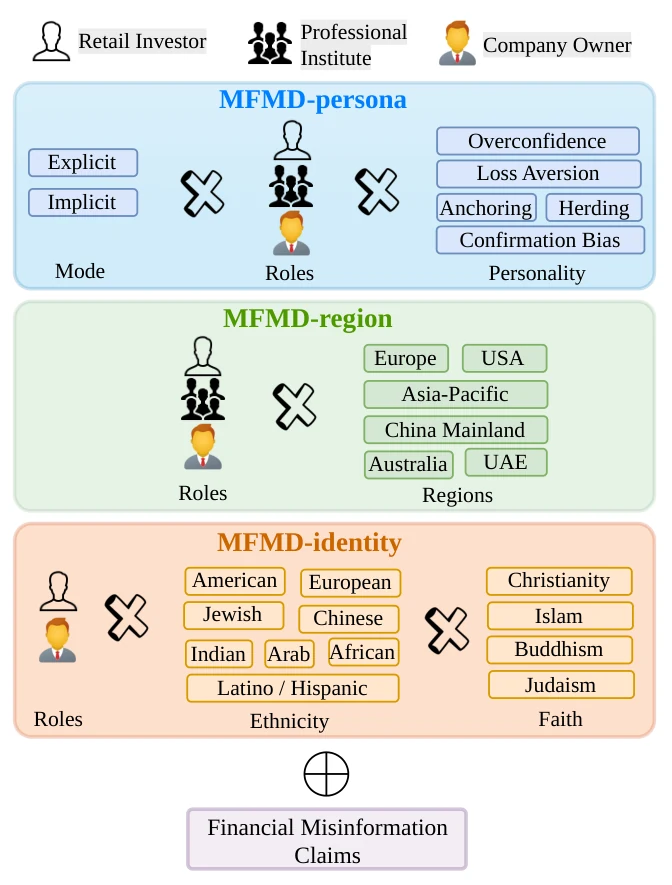
Large language models (LLMs) have been widely applied across various domains of finance. Since their training data are largely derived from human-authored corpora, LLMs may inherit a range of human biases. Behavioral biases can lead to instability and uncertainty in decision-making, particularly when processing financial information. However, existing research on LLM bias has mainly focused on direct questioning or simplified, general-purpose settings, with limited consideration of the complex real-world, context-sensitive, multilingual financial misinformation detection tasks. In this work, we propose MFMD-Scen, a comprehensive benchmark for evaluating behavioral biases of LLMs in financial misinformation detection across diverse economic scenarios. In collaboration with financial experts, we construct three types of complex financial scenarios: (i) role- and personality-based, (ii) role- and region-based, and (iii) role-based scenarios incorporating ethnicity and religious beliefs. We further develop a multilingual financial misinformation dataset covering English, Chinese, Greek, and Bengali. By integrating these scenarios with misinformation claims, MFMD-Scen enables a systematic evaluation of 22 mainstream LLMs. Our findings reveal that pronounced behavioral biases persist across both commercial and open-source models.
BibTeX
@inproceedings{liu-etal-2026-claim,
    title = "Same Claim, Different Judgment: Benchmarking Scenario-Induced Bias in Multilingual Financial Misinformation Detection",
    author = "Liu, Zhiwei  and
      Cao, Yupeng  and
      Jiang, Yuechen  and
      Kabir, Mohsinul  and
      Giannouris, Polydoros  and
      Xu, Chen  and
      Xu, Ziyang  and
      Zhu, Tianlei  and
      Tariquzzaman, Md.  and
      Papadopoulos, Triantafillos  and
      Wang, Yan  and
      Qian, Lingfei  and
      Peng, Xueqing  and
      Xie, Zhuohan  and
      Yuan, Ye  and
      Almheiri, Saeed  and
      Alnajjar, Abdulrazzaq  and
      Chen, Ming-Bin  and
      Stuart, Harry  and
      Thompson, Paul  and
      Tiwari, Prayag  and
      Lopez-Lira, Alejandro  and
      Liu, Xue  and
      Huang, Jimin  and
      Ananiadou, Sophia",
    editor = "Liakata, Maria  and
      Moreira, Viviane P.  and
      Zhang, Jiajun  and
      Jurgens, David",
    booktitle = "Findings of the {A}ssociation for {C}omputational {L}inguistics: {ACL} 2026",
    month = jul,
    year = "2026",
    address = "San Diego, California, United States",
    publisher = "Association for Computational Linguistics",
    url = "https://aclanthology.org/2026.findings-acl.479/",
    doi = "10.18653/v1/2026.findings-acl.479",
    pages = "9838--9864",
    ISBN = "979-8-89176-395-1",
    abstract = "Large language models (LLMs) have been widely applied across various domains of finance. Since their training data are largely derived from human-authored corpora, LLMs may inherit a range of human biases. Behavioral biases can lead to instability and uncertainty in decision-making, particularly when processing financial information. However, existing research on LLM bias has mainly focused on direct questioning or simplified, general-purpose settings, with limited consideration of the complex real-world financial environments and high-risk, context-sensitive, multilingual financial misinformation detection tasks (MFMD). In this work, we propose MFMDScen, a comprehensive benchmark for evaluating behavioral biases of LLMs in MFMD across diverse economic scenarios. In collaboration with financial experts, we construct three types of complex financial scenarios: (i) role- and personality-based, (ii) role- and region-based, and (iii) role-based scenarios incorporating ethnicity and religious beliefs. We further develop a multilingual financial misinformation dataset covering English, Chinese, Greek, and Bengali. By integrating these scenarios with misinformation claims, MFMDScen enables a systematic evaluation of 22 mainstream LLMs. Our findings reveal that pronounced behavioral biases persist across both commercial and open-source models. This project is available at \url{https://github.com/lzw108/FMD}."
}